
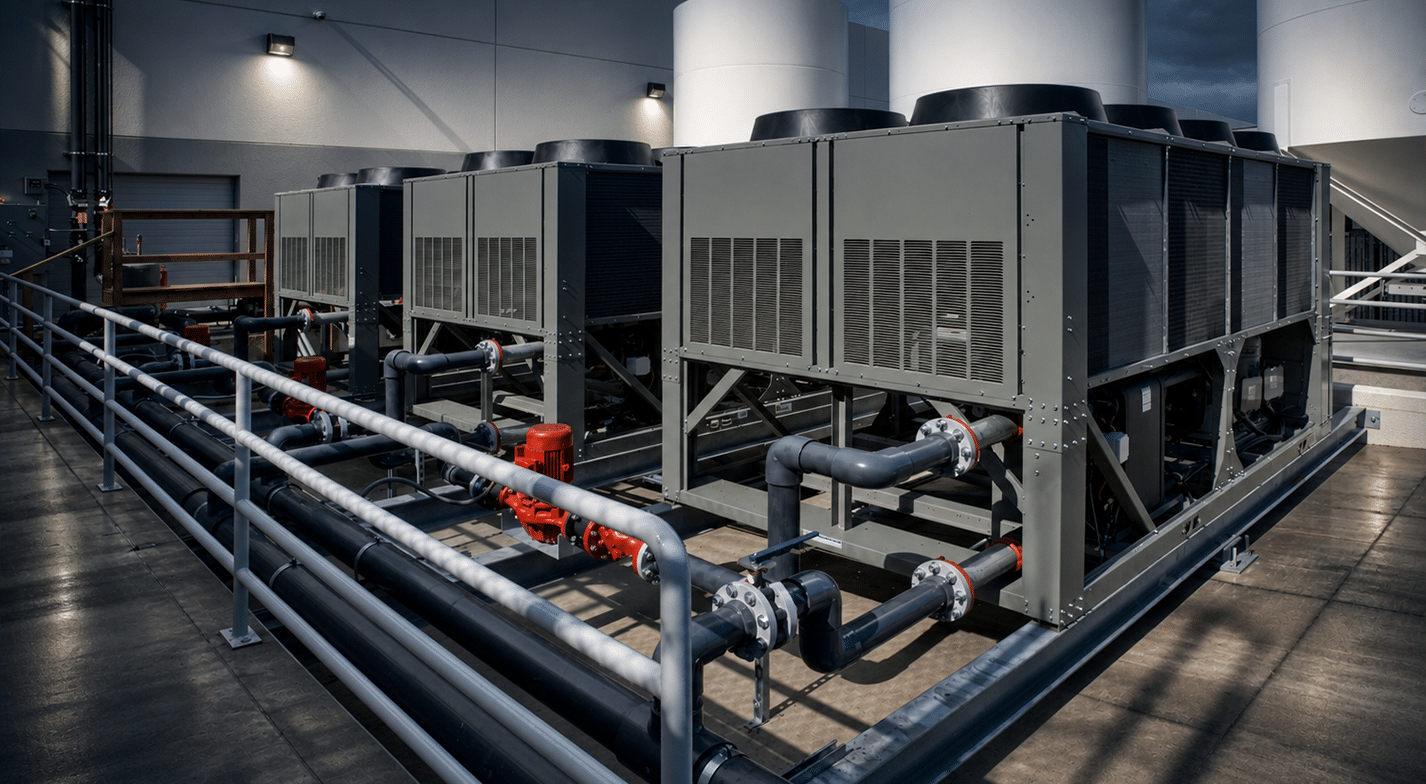
Across Georgia’s breweries, distilleries, food‑processing plants, manufacturing lines, and cold‑storage facilities, precise temperature control determines product quality, equipment longevity, and operational uptime. At Georgia Mechanical, we’ve spent nearly four decades designing, installing, and maintaining commercial HVACR and industrial cooling systems that support everything from fermentation temperature control to large‑scale heat rejection.
Two systems consistently anchor our clients’ cooling needs: glycol chillers and cooling towers. Together, they deliver the stability, efficiency, and reliability that high‑output facilities across Atlanta and North Georgia depend on every day.
Understanding Glycol Chillers: The Backbone of Precision Cooling
A glycol chiller uses a blend of water and food‑grade glycol—most commonly propylene glycol—to deliver consistent, low‑temperature cooling. This mixture prevents freezing within the system, improves heat transfer, and maintains stable temperatures even under heavy load.
Why Glycol Is the Industry Standard
Glycol offers several advantages over water-only systems:
- Freeze protection for low‑temperature applications
- Improved heat transfer through insulated glycol lines
- Stable temperature control for sensitive processes
- Longer equipment life due to reduced thermal stress
- Sanitary compatibility for food and beverage operations
These benefits make glycol chillers indispensable for breweries, distilleries, food processors, and any facility requiring precise cooling.
How Glycol Chillers Work: Inside the System
A commercial glycol chiller relies on several core components working together:
- Evaporator — absorbs heat from your process
- Condenser — rejects heat from the refrigerant
- Heat exchanger — stabilizes temperature output
- Cooling jacket — wraps tanks for precise fermentation control
- Glycol line — circulates chilled glycol throughout the facility
Many modern chillers also use A2L refrigerants, which are highly efficient and environmentally friendly, supporting lower operating costs and improved cooling capacity.
This combination of components allows glycol chillers to maintain tight temperature ranges, even during peak production.
Breweries: Where Glycol Chillers Become Mission‑Critical
Breweries across Georgia rely on glycol chillers for every stage of production. Fermentation is a living process, and yeast responds dramatically to temperature changes. Without reliable cooling, consistency becomes impossible.
Key Brewery Applications
- Fermentation temperature control for ale and lager production
- Crash cooling and cold crashing to clarify beer
- Lagering temps capability for extended cold storage
- Carbonation stability in brite tanks
- Cooling jacket performance on unitanks and jacketed tanks
- Heat transfer during wort chilling and conditioning
Whether you’re managing 1/2 bbl or 1 bbl fermenters, large unitanks, or multi‑tank fermentation chambers, glycol chillers ensure your beer develops exactly as intended.
Supporting Industry‑Standard Equipment
Georgia Mechanical services and supports systems used throughout the brewing industry, including:
- A variety of reliable commercial chiller solutions
- Commercial multi‑compressor chiller banks
- Custom glycol loop configurations
Our team understands breweries’ unique cooling demands and builds systems that scale with production growth.
Distilleries: Precision Cooling for High‑Heat Processes
Distilleries rely on glycol chillers to manage the intense heat generated during distillation. From cooling jackets on fermenters to heat exchangers used during condensation, stable cooling ensures product consistency and equipment safety.
Cooling Applications in Distilleries
- Fermentation temperature control
- Condenser cooling during distillation
- Heat exchanger stabilization
- Crash cooling for certain spirits
- Jacketed tank temperature management
Because distillation involves rapid temperature swings, glycol chillers provide the responsiveness and reliability distillers need to maintain quality.
Beyond Beverage Production: Industrial Uses for Glycol Chillers
While breweries and distilleries rely heavily on glycol systems, they’re equally essential in other industries:
- Food processing requiring sanitary, food‑grade glycol
- Cold storage facilities needing freeze protection
- Manufacturing lines with heat‑sensitive equipment
- Pharmaceutical production requiring stable temperature environments
- Data centers needing reliable cooling capacity
Any facility that depends on precise temperature control benefits from glycol chiller technology.
Cooling Towers: The Heavy‑Duty Heat Rejection System
While glycol chillers deliver precise cooling, cooling towers handle large‑scale heat rejection. These systems support chillers, industrial equipment, and high‑capacity HVAC systems by removing heat from the process and releasing it into the atmosphere.
Where Cooling Towers Excel
Cooling towers are ideal for:
- Manufacturing plants
- Industrial processing facilities
- Multi‑building commercial campuses
- Hospitals and medical centers
- Breweries and distilleries with large chiller loads
Cooling towers improve chiller performance, reduce energy consumption, and extend equipment life—especially in Georgia’s hot, humid climate, where heat-rejection efficiency is critical.
Glycol Chillers vs. Cooling Towers: How They Work Together
Many facilities use both systems simultaneously. Glycol chillers provide precise temperature control, while cooling towers support the chiller by removing heat from the refrigerant loop.
Glycol Chillers Are Best For:
- Direct process cooling
- Fermentation and brite tank control
- Freeze‑risk environments
- Food‑grade or sanitary operations
- Jacketed tank cooling
Cooling Towers Are Best For:
- Large-scale heat rejection
- High-capacity HVACR systems
- Industrial equipment cooling
- Multi-building campuses
Georgia Mechanical evaluates your cooling load, equipment type, and process requirements to determine the ideal configuration.
Maintenance: The Key to Long‑Term Cooling Performance
Both glycol chillers and cooling towers require proactive maintenance to stay efficient and avoid costly downtime.
Glycol Chiller Maintenance Includes:
- Glycol concentration testing
- Pump and compressor inspection
- Heat exchanger cleaning
- Leak detection
- Control calibration
- Glycol line flushing
Cooling Tower Maintenance Includes:
- Basin cleaning and water treatment
- Fan, motor, and belt inspection
- Drift eliminator and fill media cleaning
- Vibration analysis
- Seasonal startup/shutdown service
Georgia Mechanical provides scheduled maintenance and 24/7 emergency service across Atlanta, Suwanee, Gainesville, and North Georgia.
Why Georgia Mechanical?
Since 1987, Georgia Mechanical has delivered ‘Excellence at Every Degree’ for commercial and industrial clients. Our expertise includes:
- Commercial HVACR installation & service
- Glycol chiller installation, repair, and optimization
- Cooling tower maintenance and upgrades
- Refrigeration & cold storage systems
- Sheet metal fabrication
- 24/7 emergency response
Your operation depends on reliable cooling. We deliver it with precision, expertise, and decades of proven performance.